
From Power Frequency to Pure Energy: The Technological Evolution of Partial Discharge-Free Variable Frequency Power Supplies
In the fields of power equipment manufacturing, new energy grid integration, and high-voltage testing, Partial Discharge (PD) is known as the "invisible killer" of insulation aging.
lcxpower.com
4/22/20265 min read
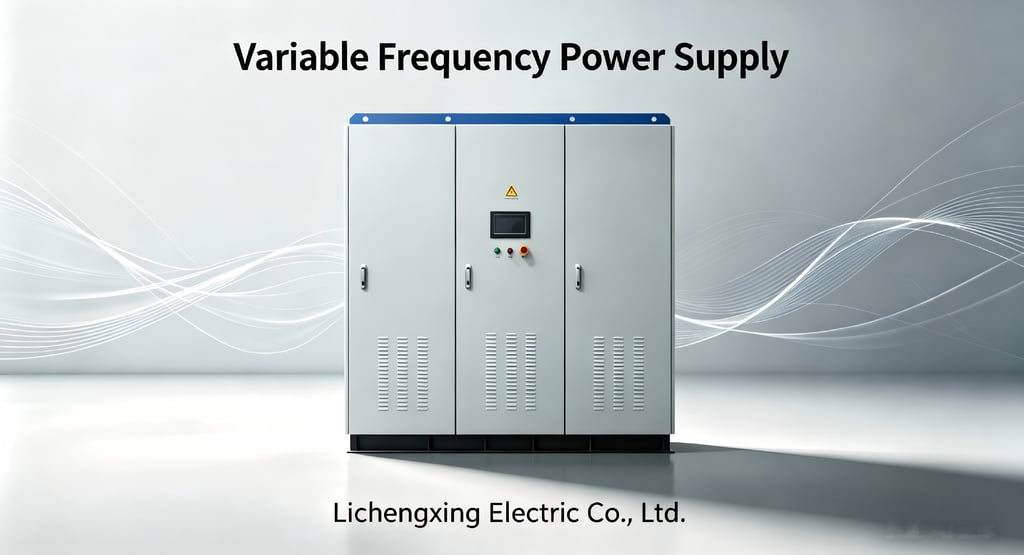
In the fields of power equipment manufacturing, new energy grid integration, and high-voltage testing, Partial Discharge (PD) is known as the "invisible killer" of insulation aging. For a long time, high-frequency interference and PD issues inherent in traditional variable frequency power supplies have constrained testing precision and equipment safety. As a high-end achievement in power electronics technology, the PD-free variable frequency power supply has undergone decades of technological iteration. Evolving from simply "suppressing interference" to "outputting pure electrical energy," it is becoming a core support for ensuring power system safety and promoting new energy development. lcxpower.com invites you to trace its technological evolution and analyze key breakthroughs and future trends.
I. Germination Period: Awakening to the Pain Points from "Power Frequency" to the "Variable Frequency Era"
Before the 1980s, power equipment testing relied on power frequency generator sets or voltage regulators, which suffered from defects such as large size, low efficiency, and fixed frequency. As the demand for insulation testing of high-voltage equipment increased, the inability of power frequency power supplies to simulate complex operating conditions became increasingly prominent:
· Limitations of Insulation Testing: Power frequency withstand voltage tests could not truly reflect the insulation status of equipment such as transformers and GIS under high-frequency resonance conditions.
· Prominent Interference Issues: The Total Harmonic Distortion (THD) of traditional power supply outputs was as high as 5%-10%, and partial discharge levels exceeded 50pC, easily causing secondary damage to the equipment under test.
· Low Efficiency: The conversion efficiency of power frequency transformers was only around 85%, and wide-frequency adjustment was impossible.
In 1985, Siemens of Germany launched the first generation of variable frequency power supplies, using thyristor rectification + GTO inverter technology to achieve frequency adjustment from 50Hz to 200Hz. However, the PD level still exceeded 30pC, meeting only basic testing needs. At this time, the concept of "PD-free" had not yet become an industry consensus, and R&D focused on power increase and frequency expansion.
II. Breakthrough Period: Core Tackling of PD-Free Technology (2000-2015)
In the early 21st century, as voltage levels of high-voltage equipment rose to 1000kV UHV, the destructive effect of partial discharge on insulation was highly valued, making PD-free technology a focus of industry R&D. The core breakthroughs in this stage lay in the collaborative innovation of materials, structure, and control algorithms:
1. Insulation Revolution: From "Traditional Materials" to "Composite Insulation Systems"
· Material Upgrade: Adopting a multi-layer insulation structure of Polyimide (PI) film + epoxy resin potting, the breakdown field strength increased from 15kV/mm of traditional materials to over 30kV/mm.
· Electric Field Optimization: Designing transformer windings and busbars through Finite Element Analysis (FEA) to eliminate sharp corner structures, controlling local field strength below 2kV/mm.
· Sealing Process: Filling the equipment interior with 99.99% high-purity nitrogen or vacuum encapsulation to avoid air gap discharge, stabilizing PD levels below 10pC for the first time.
1. Topology Innovation: Efficiency Leap from "Hard Switching" to "Soft Switching"
· Phase-Shifted Full-Bridge Topology: Replacing traditional hard-switching inverters, reducing switching losses by 70% and harmonic distortion to below 1%.
· Multi-stage Filtering System: A combination of front-end EMI filters + rear-end sine wave filters completely eliminated high-frequency switching noise.
· Isolation Transformer Innovation: Using nanocrystalline alloy cores reduced hysteresis loss by 50% while achieving electrical isolation and PD suppression.
1. Control Algorithms: From "Open-Loop Regulation" to "Dual Closed-Loop Precision Control"
· DSP Digital Control: Using the TI TMS320F28335 chip to achieve continuously adjustable frequency with 0.1Hz steps.
· Dual Closed-Loop Feedback: Voltage outer loop + current inner loop control strategy, with voltage recovery time <10ms during load surges and stability of ±0.5%.
· SPWM Optimization: AI-based adaptive modulation algorithms dynamically adjusted pulse width to further reduce harmonic interference.
In 2012, ABB launched the first PD-free variable frequency power supply with PD levels ≤5pC, marking that the technology maturity had reached the industrial application level, gradually becoming standard for power equipment factory testing.
III. Intelligent Era: Deep Integration of Modularity and Networking (2015-Present)
In recent years, Industry 4.0 and the new energy revolution have driven PD-free variable frequency power supplies to evolve towards modularity, intelligence, and green development. Core breakthroughs lie in the reconstruction of system architecture:
1. Modular Architecture: From "Integration" to "Block-style Combination"
· Power Unit Standardization: Using 25kVA/50kVA standard modules, flexible power configuration from 50kVA to 2000kVA is achieved through series/parallel connection. Power density reaches 50kVA/㎡, reducing volume by 40% compared to traditional equipment.
· N+1 Redundancy Design: The system remains stable during single module failures; faulty modules support online hot-swapping (replacement time <15 minutes), reducing Mean Time To Repair (MTTR) by 80%.
· Plummeting Maintenance Costs: Single module replacement costs only 8,000-12,000 RMB, annual maintenance costs are reduced by 75%, and spare part types are streamlined from 23 to 5.
1. Intelligent O&M: From "Passive Repair" to "Active Prediction"
· AI Adaptive Control: Deep learning algorithms analyze load characteristics (capacitive/inductive/rectifying) to automatically optimize PWM strategies, reducing harmonic distortion to below 0.5%.
· IoT Integration: Built-in 5G communication modules collect 23 operational parameters (temperature, voltage, PD level, etc.) in real-time, enabling remote monitoring and fault warning.
· Digital Twin Technology: Simulates equipment aging trends, warning of insulation defects 6 months in advance; one grid company application reduced unplanned downtime by 60%.
1. New Energy Adaptation: From "Single Testing" to "Source-Grid-Load-Storage Hub"
· Wide-Frequency Regulation: Achieving full frequency coverage of 0.1Hz-2000Hz, adapting to wind turbine pitch systems (0.5Hz-60Hz) and PV inverter LVRT testing (voltage dip simulation).
· Virtual Synchronous Machine Technology: Simulates synchronous generator inertia characteristics to enhance new energy grid stability, meeting GB/T 36992-2018 grid connection standards.
· Bidirectional Conversion Function: Supports AC/DC bidirectional conversion, adapting to AC/DC hybrid microgrids for flexible power dispatching.
IV. Typical Applications: Realizing Industry Value of Technological Evolution
1.UHV Equipment Testing: From "Qualitative Judgment" to "Quantitative Analysis"
In a handover test for GIS equipment at a 500kV substation, traditional power frequency power supplies could not detect micro-PD. Using a modular PD-free power supply outputting 630kV/50Hz voltage with background PD ≤3pC, a 12pC PD signal from the Phase B disconnecting circuit breaker was successfully detected. This located an air bubble defect in the insulating basin, avoiding a breakdown accident after commissioning and saving economic losses of over 10 million RMB.
2.New Energy Grid Connection Testing: From "Simulated Conditions" to "Real Scenario Reproduction"
When a PV inverter enterprise exported to Japan, they needed to simulate the Japanese grid conditions of 400V/50Hz with ±10% voltage fluctuation. The PD-free variable frequency power supply verified the inverter's reliability in complex grid environments through precise waveform control, helping the product pass JET certification smoothly and increasing exports by 30%.
3.Industrial Motor Aging Tests: From "Power Frequency Acceleration" to "High-Frequency Precision Aging"
Traditional power frequency aging tests required 1000 hours. Applying 1000Hz high-frequency high voltage with a PD-free variable frequency power supply increased the aging rate by 5 times, compressing the test cycle to 200 hours. Meanwhile, PD was controlled within 5pC, avoiding additional damage to motor insulation.
V. Future Trends: From "Pure Output" to "Energy Ecosystem Hub"
1.Wide Bandgap Semiconductor Revolution: SiC/GaN Leading High Frequency
Replacing IGBTs with SiC MOSFETs increases switching frequency from 20kHz to over 100kHz, shrinking transformer volume by 60% and breaking through power density to 100kVA/㎡, suitable for space-constrained scenarios like shipborne and aviation applications.
2.Green Power Direct Supply: Deep Integration with New Energy
Developing AC/DC bidirectional PD-free power supplies to directly connect DC energy sources like PV and wind power, reducing AC/DC conversion losses and realizing flexible dispatching of "Source-Grid-Load-Storage" integrated systems.
3.Global Standard Coordination: Solving Grid Fragmentation
Promoting the unification of international PD-free power supply standards to solve adaptation problems for different national grids (50Hz/60Hz/400Hz), aiding the global export of Chinese power equipment.
4.Quantum Sensing Technology: PD Detection Precision Breaks 1pC
Integrating quantum sensors to increase PD detection sensitivity from 3pC to 1pC, realizing early warning of insulation defects and further extending power equipment life.
The technological evolution history of PD-free variable frequency power supplies is a history of power electronics development from "solving pain points" to "leading innovation." From the initial power frequency power supply to today's modular intelligent systems, every breakthrough has driven the improvement of power testing precision and equipment safety. In the future, with the integration of wide bandgap semiconductors, AI, and quantum technology, PD-free variable frequency power supplies will not only be testing equipment but will become "pure energy hubs" in the energy internet, providing core support for the safe and stable operation of power systems and large-scale new energy grid integration.