
Lcxpower.com: Research on Optimization Scheme for Long-Term Operational Stability of Partial Discharge-Free Variable Frequency Test Power Supply
A partial discharge (PD)-free variable frequency test power supply is core equipment for partial discharge detection in high-voltage electrical equipment (such as power transformers, gas-insulated switchgear, cables, etc.).
lcxpower.com
4/19/20266 min read
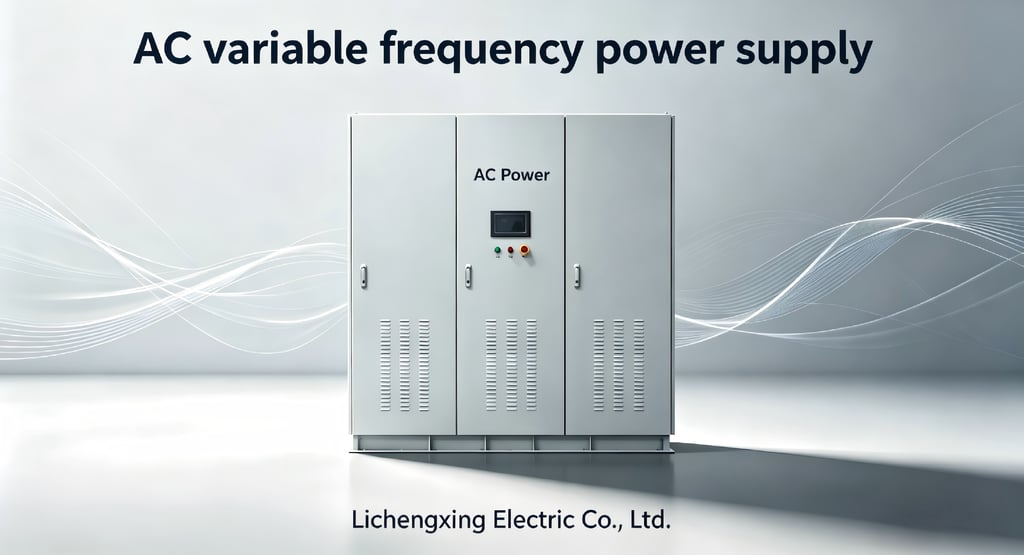

A partial discharge (PD)-free variable frequency test power supply is core equipment for partial discharge detection in high-voltage electrical equipment (such as power transformers, gas-insulated switchgear, cables, etc.). Its long-term operational stability directly determines the accuracy and reliability of detection data. In scenarios including factory testing of power equipment, on-site handover testing, and operation and maintenance detection, the power supply must maintain extremely low PD levels (≤5pC) and output precision continuously for hours or even tens of days. However, complex on-site environments, component aging, electromagnetic interference, and other factors often cause problems such as PD level drift and output fluctuations. lcxpower.com proposes an optimization scheme for the long-term operational stability of PD-free variable frequency test power supplies from four dimensions: core components, environmental adaptation, intelligent monitoring, and redundant architecture.
I. Core Component Reliability: Suppressing Performance Degradation from the Source
The long-term stability of a PD-free variable frequency power supply first depends on the lifespan and performance retention capability of its core components. Optimization is required for three key links: power conversion, insulation system, and passive components:
1.Selection and Layout of Wide-Temperature-Range Power Semiconductor Devices
Power semiconductors are the "heart" of the power supply, and their performance degradation directly affects output stability. The optimization scheme selects silicon carbide (SiC) MOSFETs to replace traditional silicon-based IGBTs. SiC devices have higher switching frequencies and lower conduction losses, with an operating temperature range of -40℃ to 175℃. Under long-term full-load operation, junction temperature fluctuations are smaller, and the aging rate is reduced by more than 60%. Meanwhile, a modular parallel layout is adopted, with each power unit independently packaged and equipped with an independent heat dissipation channel, reducing thermal coupling between devices and avoiding performance drift caused by local overheating.
2.PD-Suppression Insulation System Design
Partial discharge is the core trigger for the increase of the power supply's own PD level, which needs to be suppressed from the dual dimensions of insulation materials and structural design:
3. Insulation Material Upgrade: The main circuit insulation uses nano-composite epoxy resin casting, reducing the internal void rate of the material to below 0.1%. Compared with traditional epoxy resin, the partial discharge inception voltage (PDIV) is increased by 40%; winding insulation uses polyimide film wrapping, with a corona resistance life more than 10 times that of ordinary polyester film.
· Structural Optimization: High-voltage terminals adopt an equalizing sphere design to eliminate electric field concentration areas; an insulation buffer layer is set between power modules and the cabinet to reduce insulation wear caused by mechanical vibration, avoiding the generation and accumulation of PD signals from the source.
4. Selection and Screening of Long-Life Passive Components
Aging of passive components such as capacitors and inductors is a common failure point in long-term power supply operation:
· DC-link capacitors use metallized polypropylene film capacitors, whose self-healing performance can automatically repair local breakdown points, with a service life of more than 15 years, three times that of electrolytic capacitors;
· Output filter inductors are wound with oxygen-free copper wire, surface-coated with high-temperature-resistant insulating paint, and screened through -40℃ to 125℃ high-low temperature cycles to ensure that the inductance value change rate is ≤1% during long-term operation;
· All passive components undergo a 1000-hour high-temperature aging test to eliminate early-failure products and improve batch consistency.
II. Enhanced Environmental Adaptability: Resisting Interference from Complex Operating Conditions
Power equipment detection scenarios often face harsh environments such as temperature fluctuations, dust, humidity, and electromagnetic interference, requiring targeted environmental adaptation solutions:
1、Intelligent Temperature Control and Heat Dissipation System
A dual-mode temperature control strategy of "active preheating + liquid cooling" is adopted:
l In low-temperature environments (≤5℃), PTC ceramic heaters preheat core components such as power modules and capacitors, maintaining the internal ambient temperature above 10℃ to avoid device performance degradation caused by low temperatures;
l In high-temperature environments, a sealed liquid cooling circulation system is used, with heat dissipated through plate heat exchangers. Combined with dynamic adjustment by flow sensors and temperature sensors, it ensures that core component temperatures remain stable in the optimal range of 60℃ to 80℃. Compared with traditional air cooling, thermal efficiency is increased by 50%, and dust entry into the interior is avoided.
2、Dustproof and Moisture-Proof Sealed Protection Structure
The power supply cabinet adopts an IP54-level sealed design, combined with multiple protective measures:
· Silicone rubber sealing strips are used at cabinet joints,coordinate with pressure balance valves, to avoid seal failure caused by internal-external pressure differences;
· Ventilation ports are equipped with HEPA high-efficiency air filters, with a filtration precision of 0.3μm, capable of blocking 99.97% of dust particles, and featuring an automatic cleaning function that removes filter screen dust accumulation through regular back-blowing;
· Humidity sensors and dehumidification modules are installed internally. Dehumidification is automatically activated when humidity ≥60%RH, ensuring that internal relative humidity remains stable at 30% to 50%, preventing insulation components from getting damp and causing PD.
3、Electromagnetic Compatibility and Anti-Interference Optimization
For complex on-site electromagnetic environments, anti-interference capability is strengthened from three aspects: shielding, grounding, and filtering:
· The cabinet is welded from double-layer cold-rolled steel plates, with conductive paint sprayed internally to form a fully enclosed electromagnetic shielding cavity, with an attenuation of external electromagnetic radiation ≥60dB;
· A star-type grounding system is adopted, with power ground, signal ground, and shield ground led out independently and grounded at a single point to avoid ground loop interference with control signals;
· EMI filters are configured in input and output circuits to suppress grid-side harmonics and electromagnetic interference generated by the equipment itself, ensuring no significant PD level drift in strong electromagnetic environments (such as substation sites).
III. Intelligent Monitoring and Early Warning: Achieving Full Lifecycle Management
By building a multi-dimensional state perception and fault prediction system, potential faults are discovered in advance to avoid sudden stability degradation:
1. Multi-Dimensional State Perception Network
More than 20 types of sensors are deployed inside the power supply to achieve real-time monitoring of key parameters:
· PD Monitoring: Ultra-high frequency (UHF) sensors are installed at PD-sensitive points such as power modules and high-voltage terminals to collect PD signals in real time, with a resolution of up to 1pC;
· Temperature Monitoring: Fiber optic temperature sensors are used to monitor the junction temperature of power devices and winding temperature, with a measurement accuracy of ±0.5℃, avoiding electromagnetic interference from traditional thermocouples;
· Electrical Parameter Monitoring: Input/output voltage, current, frequency, and harmonic content are collected in real time to record long-term performance change trends.
2. Fault Prediction and Health Management (PHM)
A health assessment model is built based on monitoring data to achieve early fault warnings:
· By analyzing the change rate of capacitor equivalent series resistance (ESR), capacitor aging degree is predicted, with replacement needs warned six months in advance;
· By comparing changes in the on-state voltage drop of power devices, device performance degradation trends are judged, with warnings issued when the degradation rate exceeds 10%;
· Statistical analysis of PD signal amplitude and frequency is performed. When PD levels rise by more than 2pC for three consecutive days, insulation abnormality is determined, triggering an alarm and pushing maintenance recommendations.
3. Remote Operation and Maintenance and Diagnostic Platform
The power supply has a built-in industrial-grade 4G/5G communication module that can upload monitoring data to a cloud-based operation and maintenance platform:
· Operation and maintenance personnel can remotely view the power supply's real-time status, historical operation curves, and fault records;
· The platform supports remote firmware upgrades and parameter adjustments, optimizing power supply performance without on-site operations;
· For complex faults, remote desktop assistance can be used for diagnosis, greatly shortening fault troubleshooting time.
IV. Redundant Fault-Tolerant Architecture: Avoiding Downtime Caused by Single-Point Failures
To ensure reliability for long-term continuous operation, a modular redundancy and dual-redundancy control architecture is adopted:
1. N+1 Modular Power Unit Redundancy
The power section of the power supply adopts an N+1 modular design, with each power unit independently controlled and hot-swappable:
· When a power unit fails, the system can automatically cut off the faulty unit and switch to the backup unit within 10ms, with output voltage fluctuations ≤±1%, without affecting the normal progress of detection tests;
· Current sharing control is used between modules to ensure load balancing across units, avoiding single-module overload aging and extending overall service life.
2. Dual-Redundancy Control and Protection System
The control unit adopts a master-slave CPU hot backup design:
· The master CPU is responsible for normal operation control, while the slave CPU synchronizes operational data in real time. When the master CPU fails, the slave CPU can take over control within 5ms, maintaining power supply output without interruption;
· The protection system uses a dual mechanism of hardware protection + software protection. Hardware protection achieves rapid cutoff for overvoltage, overcurrent, and overheating through independent relays, with a response time ≤1ms. Software protection provides secondary confirmation and fault recording to avoid false operations.
V. Engineering Application Case
A power equipment testing research institute applied the above optimization scheme to a 1000kVA/10kV PD-free variable frequency test power supply. After 18 months of on-site operation verification:
· After 90 days of continuous operation, PD levels remained stable below 3pC with no significant drift;
· In temperature environments ranging from -10℃ to 40℃, output voltage accuracy remained within ±0.5%;
· The failure rate decreased from 1.2 times/month before optimization to 0.1 times/month, with mean time between failures (MTBF) increased to more than 80,000 hours;
· The remote operation and maintenance platform issued a total of three early warnings for potential faults, all of which were maintained without affecting detection, effectively ensuring the continuity of detection tasks.
The long-term stable operation of a PD-free variable frequency test power supply is a multi-dimensional systems engineering project spanning from core components to intelligent monitoring. It not only effectively suppresses PD drift and component aging but will also leverage AI and digital twin technology to move toward a "zero-fault" future, providing solid support for high-voltage detection.
Achieving this goal is inseparable from profound professional accumulation. With more than ten years of manufacturing experience, lcxpower.com is well-versed in this field. If your equipment is troubled by an unstable grid environment, choosing an lcxpower.com variable frequency power supply is a strategic choice for your precise detection and long-term benefits.