
Research on Bidirectional Power Flow Control Technology of MPPT Controllers in Ship DC Grids
Driven by the International Maritime Organization's (IMO) "decarbonization" targets, ship electrification and the adoption of new energy sources have become central development directions for the industry.
lcxpower.com
4/19/20265 min read
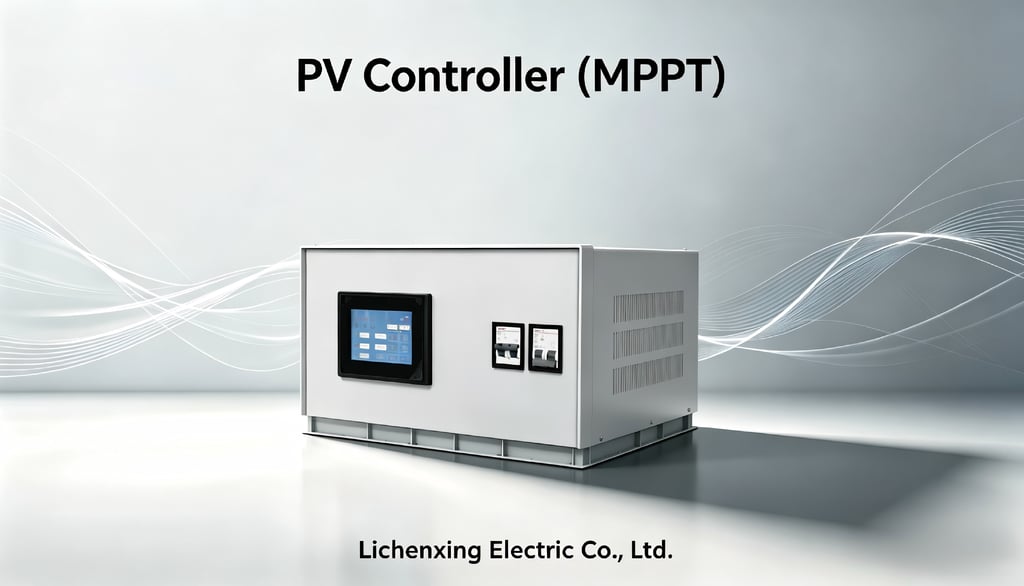

Driven by the International Maritime Organization's (IMO) "decarbonization" targets, ship electrification and the adoption of new energy sources have become central development directions for the industry. Due to advantages such as high power transmission efficiency and strong compatibility, DC grids are gradually replacing traditional AC grids to become the mainstream architecture for ship energy systems. The integration of distributed new energy sources like photovoltaics and wind power provides clean power for ships; however, the contradiction between the intermittency and volatility of new energy and the dynamic changes in ship loads (such as the start/stop of propulsion systems and fluctuations in living loads) is becoming increasingly prominent.
Traditional Maximum Power Point Tracking (MPPT) controllers can only achieve unidirectional power transmission from new energy sources to the DC grid, failing to adapt to the full-scenario requirements of ships involving "new energy supply - energy storage charge/discharge - grid load regulation." The bidirectional power flow control MPPT controller, by breaking through unidirectional power limitations, can not only efficiently capture maximum new energy power but also achieve reverse power regulation (such as energy storage charging and grid voltage stabilization), becoming a key core device for the stable operation and optimized energy utilization of ship DC grids.
Special Requirements of Ship DC Grids for MPPT Controllers
The operating environment of ship DC grids differs significantly from land-based grids, posing higher bidirectional control requirements for MPPT controllers:
· Multi-energy Synergy: Ships typically integrate multiple energy sources such as photovoltaics, diesel generators, and energy storage batteries. MPPT controllers are required to prioritize power supply when new energy is sufficient and coordinate energy storage discharge when insufficient to achieve energy complementarity.
· Dynamic Load Response: The start/stop of high-power loads like ship propulsion systems and cranes causes drastic grid power fluctuations. MPPT controllers must rapidly switch power flow directions to maintain grid voltage stability.
· Harsh Environment Adaptability: Ships face extreme environments during navigation, including high temperatures, high humidity, strong vibrations, and salt spray corrosion. Bidirectional MPPT controllers must possess industrial-grade reliability and anti-interference capabilities.
· Space and Efficiency Constraints: Ship cabin space is limited, requiring controllers to have high power density. Additionally, due to high fuel costs, bidirectional power conversion efficiency must not be lower than 98%.
Operating Modes and Core Logic of Bidirectional Power Flow MPPT Controllers
Bidirectional MPPT controllers achieve seamless switching between "forward MPPT generation - reverse power regulation" through modular topology design and intelligent control strategies, adapting to the complex working conditions of ship DC grids.
1. Forward Operating Mode: New Energy Maximum Power Capture
When new energy sources like photovoltaics and wind power have sufficient output, the controller operates in forward MPPT mode:
· By monitoring new energy output characteristics in real-time (such as the voltage-power curve of PV modules), it dynamically adjusts the operating point to ensure new energy always operates at the maximum power point.
· It steps up/down the new energy electricity and feeds it into the ship DC grid, prioritizing load demand. Excess electricity can charge energy storage batteries through the reverse channel.
1. Reverse Operating Mode: Power Regulation and Grid Support
When new energy output is insufficient or loads change abruptly, the controller switches to reverse operating mode to achieve bidirectional power flow:
· Energy Storage Discharge Mode: When grid voltage drops below a threshold, the controller converts high-voltage electricity from energy storage batteries into electricity matching the grid voltage to fill the grid power gap.
· Grid Voltage Stabilization Mode: When the startup of high-power loads causes grid voltage drops, the controller rapidly outputs reverse power to suppress voltage fluctuations and maintain grid stability.
· Shore Power Charging Mode: When the ship docks and connects to shore power, the controller acts as a rectifier, converting shore power electricity into charging voltage for energy storage batteries to achieve efficient charging.
1. Mode Switching Logic: Intelligent Perception and Seamless Connection
The controller automatically determines the operating mode through real-time data exchange with the Ship Energy Management System (EMS):
· It predicts power flow direction requirements in advance based on multi-dimensional data such as new energy output, load demand, and energy storage SOC (State of Charge).
· It employs soft switching technology to achieve millisecond-level switching between forward/reverse modes, avoiding grid impact and power interruption.
Key Value of Bidirectional MPPT Controllers in Ship DC Grids
1.Improving New Energy Utilization and Reducing Fuel Consumption
Traditional unidirectional MPPT controllers cannot store excess electricity when new energy output exceeds load, leading to waste through "curtailment." Bidirectional MPPT controllers can store excess electricity in energy storage batteries, increasing new energy utilization from around 70% to over 95%, and reducing annual fuel consumption per ship by 10%-15%.
2.Enhancing Grid Stability and Power Supply Reliability
Dynamic fluctuations in ship loads can easily cause DC grid voltage fluctuations. Through reverse power regulation, bidirectional MPPT controllers can control voltage fluctuation rates within ±2%, far superior to the ±5% threshold of traditional grids. Simultaneously, in the event of diesel generator failure, they can rapidly switch to energy storage discharge mode to provide emergency power for critical loads (such as navigation and communication systems).
3.Supporting Shore Power Interaction and Aiding Port Greening
When ships dock, bidirectional MPPT controllers can achieve efficient interaction between shore power and energy storage: charging energy storage with shore power during off-peak hours and using energy storage to supply power during peak hours. This reduces shore power capacity requirements, lowers load pressure on port grids, and reduces ship operating costs by utilizing peak-valley electricity price differences.
4.Simplifying System Architecture and Reducing Maintenance Costs
Bidirectional MPPT controllers integrate multiple functions such as MPPT generation, energy storage charge/discharge, and grid voltage stabilization, replacing the traditional multi-device architecture of "unidirectional MPPT + charger + inverter." This reduces cabin space occupation and equipment maintenance volume, increasing system reliability by over 30%.
Technical Challenges and Solutions
1. Extreme Environment Adaptability Challenges
The high temperature, high humidity, and strong vibration environments of ships can easily cause controller failures. Solutions include:
· Using SiC (Silicon Carbide) wide bandgap power devices, which can withstand temperatures up to 175℃ and have double the vibration resistance capability.
· Adopting sealed potting processes and anti-corrosion coatings to achieve IP67 protection ratings, adapting to salt spray corrosion environments.
· Designing redundant cooling systems combining liquid and air cooling to ensure stable controller operation at cabin temperatures of 40℃.
1. Bidirectional Switching Response Speed Challenges
Abrupt ship load changes require controllers to complete mode switching within 10ms. Solutions include:
· Using FPGA (Field-Programmable Gate Array) real-time control to achieve microsecond-level power regulation.
· Optimizing power topology structures to reduce the number of switching tubes and switching losses, thereby improving response speed.
1. Electromagnetic Compatibility (EMC) Challenges
Complex ship electromagnetic environments can easily interfere with controller signals. Solutions include:
· Adopting multi-layer shielding designs to isolate power circuits from control circuits.
· Optimizing PCB layouts to reduce electromagnetic radiation and conducted interference.
· Complying with IEC 60945 ship electrical equipment EMC standards to ensure compatibility with other ship systems.
Application Case: Practical Results on a Hybrid Hybrid Bulk Carrier
A Chinese 100,000-ton hybrid bulk carrier installed 12 sets of bidirectional MPPT controllers, integrating a 500kW photovoltaic system and 2MWh energy storage batteries. After one year of operation, the results were significant:
· Photovoltaic utilization increased from 68% to 96%, with annual power generation increasing by 120MWh.
· Fuel consumption decreased by 12%, reducing annual CO₂ emissions by approximately 380 tons.
· DC grid voltage fluctuation rates remained stable within ±1.5%, and power supply reliability increased to 99.99%.
· Through shore power and energy storage interaction while docking, annual shore power cost savings were approximately 200,000 RMB.
The bidirectional power flow control MPPT controller breaks through the unidirectional transmission limitations of traditional MPPT, providing an efficient, flexible, and reliable energy management solution for ship DC grids. It is one of the core technologies for ship electrification and green transformation. In the future, with the development of ship intelligent energy management systems, bidirectional MPPT controllers will further integrate with AI algorithms to achieve autonomous learning and optimized scheduling. Simultaneously, with the integration of new energy sources like hydrogen fuel cells, bidirectional MPPT controllers will expand into the field of multi-energy collaborative control, providing stronger technical support for achieving ship "zero carbon" targets.