
Technical Pathways and Practices of DC Shore Power Systems in Supporting Ports' "Dual Carbon" Goals
As critical nodes in the global supply chain, ports are also significant sources of carbon emissions. According to the International Maritime Organization (IMO), fuel consumption by ships while docked accounts for 10%–15% of their total fuel use, resulting in approximately 120 million tons of CO₂ and 8 million tons of nitrogen oxides (NOₓ) emitted annually—making ship operations a major contributor to air pollution in port areas.
lcxpower.com
7/3/20266 min read
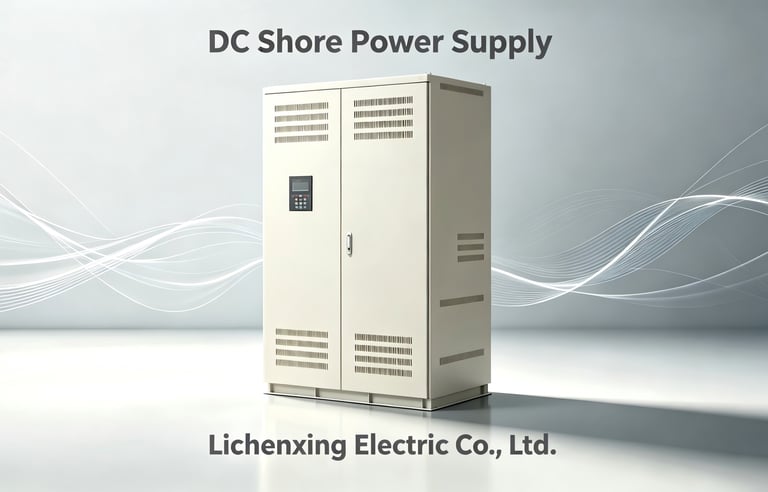
As critical nodes in the global supply chain, ports are also significant sources of carbon emissions. According to the International Maritime Organization (IMO), fuel consumption by ships while docked accounts for 10%–15% of their total fuel use, resulting in approximately 120 million tons of CO₂ and 8 million tons of nitrogen oxides (NOₓ) emitted annually—making ship operations a major contributor to air pollution in port areas. To advance China’s “dual carbon” goals (carbon peaking before 2030 and carbon neutrality before 2060), the country has mandated that shore power coverage at ports exceed 70% by 2030. Among available solutions, DC (direct current) shore power systems are gradually replacing traditional AC (alternating current) systems due to their superior efficiency, flexibility, and compatibility with renewable energy sources, emerging as a core technology for port decarbonization. This paper begins by analyzing the pain points of port carbon emissions and the technical requirements for shore power, then systematically elaborates on the advantages of DC shore power and its key pathways toward achieving carbon neutrality.
1. Pain Points of Port Carbon Emissions and Shore Power Requirements
1.1 Core Sources of Port Carbon Emissions
Port-related carbon emissions fall into three main categories:
· Emissions from docked ships: Ships must run auxiliary engines to generate electricity while docked. A single 50,000-ton bulk carrier consumes about 10 tons of fuel per day in port, emitting roughly 31.8 tons of CO₂ and 0.3 tons of sulfur oxides (SOₓ).
· Emissions from port operations: Electricity used by cargo-handling machinery, lighting, and refrigeration systems. If this power comes from conventional coal-fired grids, it results in indirect carbon emissions.
· Emissions from land-side logistics: Fuel consumption by trucks and terminal tractors accounts for 20%–30% of total port emissions.
1.2 Limitations of Traditional AC Shore Power
Although AC shore power can replace onboard diesel generators, it suffers from three major drawbacks:
· Low efficiency: AC systems require multiple conversion stages—“grid AC → ship transformer → ship load”—resulting in overall efficiency of only 80%–85%, along with reactive power loss and harmonic pollution.
· Poor compatibility: Ships vary widely in voltage levels (400V, 6.6kV, 10kV) and frequencies (50Hz/60Hz), requiring complex and costly variable-frequency drives (VFDs) and transformers, which also respond slowly.
· Difficulty integrating renewables: Distributed renewable sources like solar PV and wind turbines typically output DC power. Connecting them to AC shore power requires additional rectification, increasing conversion losses.
1.3 Technical Advantages of DC Shore Power
DC shore power supplies ships directly with DC electricity, offering significant benefits over AC systems:
· High efficiency and energy savings: By eliminating AC-DC-AC conversion stages, DC systems achieve 92%–95% efficiency. A single ship docked for one day can reduce CO₂ emissions by approximately 1.5 tons.
· Wide voltage adaptability: Using bidirectional DC/DC converters, DC shore power can flexibly match shipboard DC grids ranging from 200V to 10kV without complex transformers or frequency converters.
· Renewable-friendly: PV and wind power (typically DC) can be directly connected to the DC bus, enabling “source-grid-ship” DC interconnection and significantly improving renewable energy utilization.
· Energy storage integration: DC systems seamlessly integrate with battery storage for peak shaving, valley filling, emergency backup, and smoothing renewable fluctuations—further reducing carbon footprints.
2. Core Technical Pathways for DC Shore Power to Support "Dual Carbon" Goals
2.1 High-Efficiency DC Shore Power System Architecture
The core of a DC shore power system lies in building a DC energy hub integrating “grid–renewables–storage–ship.” A typical architecture includes:
· Bidirectional AC/DC rectifier unit: Converts grid AC to DC bus power and vice versa. Using SiC/GaN wide-bandgap semiconductors, switching frequencies exceed 20kHz, achieving ≥98% conversion efficiency while suppressing harmonics.
· DC bus and distribution network: Employs ±10kV high-voltage DC buses to minimize transmission losses. Intelligent circuit breakers enable flexible power supply to multiple vessels, with distribution losses ≤1%.
· Ship-side DC/DC adaptation unit: Modular bidirectional DC/DC converters adapt to various ship voltage levels (200V–10kV). Each module delivers up to 1MW, supporting hot-swapping and redundancy.
2.2 Integration of Distributed Renewable Energy
Renewables like solar and wind are directly connected to the DC bus for efficient utilization:
· DC-coupled PV integration: Distributed PV installations on port rooftops, yards, and roads feed DC power directly into the shore power bus—eliminating rectifiers and boosting conversion efficiency by 5%–8%. For example, Shanghai’s Waigaoqiao Port installed a 10MW PV system generating ~12 million kWh annually, powering ~300 ship calls and reducing CO₂ by ~9,500 tons per year.
· Coordinated wind-solar-storage dispatch: Battery storage (e.g., LiFePO₄) smooths renewable fluctuations. Excess generation charges batteries; deficits are covered by discharge. Smart dispatch can raise renewable utilization rates above 90%.
2.3 Shipboard DC Grid Retrofit Technologies
To fully leverage DC shore power, ships require internal DC grid upgrades:
· DC conversion of auxiliary machinery: Replacing AC auxiliaries (e.g., HVAC, pumps, lighting) with DC motors reduces onboard AC/DC losses, improving ship energy efficiency by ~10%.
· Onboard DC distribution network: Low-voltage DC buses (400V/800V) interconnect shore power, ship batteries, and auxiliaries into a shipboard microgrid, further cutting energy use.
· Rapid shore power connection: Standardized DC connectors and communication protocols enable automatic recognition and connection in under 5 minutes—down from 30 minutes—boosting operational efficiency.
2.4 Intelligent Energy Management and Carbon Accounting
Digital platforms enable smart dispatch and quantified carbon reduction:
· Multi-source optimization: AI algorithms predict ship schedules, renewable output, and grid pricing to optimize energy allocation—prioritizing renewables, charging during off-peak hours, and discharging during peaks—reducing grid costs and emissions.
· Lifecycle carbon accounting: A carbon footprint model covers “manufacturing–construction–operation–recycling,” quantifying emissions reductions from fuel displacement, efficiency gains, and renewable use. A 10MW DC shore power system can cut ~35,000 tons of CO₂ annually—equivalent to planting 190,000 trees.
2.5 Land-Side Equipment DC Conversion for Reduction
Extending DC systems to port land-side equipment enables port-wide decarbonization:
· DC retrofit of cargo-handling machinery: Converting AC-powered gantry cranes and container handlers to DC drive reduces AC/DC losses and increases efficiency by ~5%, cutting ~200 tons of CO₂ per unit annually.
· Electric truck battery swap networks: DC shore power systems support battery swap stations for electric terminal trucks, replacing diesel vehicles. Each electric truck reduces ~15 tons of CO₂ per year.
3. Typical Application Cases
3.1 Shenzhen Mawan Port DC Shore Power Demonstration Project
Mawan Port deployed China’s first high-voltage DC shore power system, featuring a ±10kV DC bus, 5MW PV, and 2MW storage, capable of powering two 100,000-ton container ships simultaneously. Post-implementation, docked ships achieved zero fuel consumption, with annual reductions of ~120,000 tons of CO₂ and 380 tons of SOₓ. Renewable utilization reached 85%, and shore power efficiency improved by 15% over AC systems.
3.2 Qingdao Port “PV-Storage-Shore-Ship” Integrated Project
At Dongjiakou Terminal, Qingdao Port installed a 20MW PV array, 5MW storage, and 15MW DC shore power system, coordinated via an intelligent dispatch platform. The system generates ~24 million kWh annually, serving ~600 ship calls and reducing CO₂ by ~19,000 tons. Peak-valley arbitrage generates ~3 million CNY in annual revenue—achieving both environmental and economic benefits.
4. Challenges and Future Outlook
4.1 Current Challenges
· High ship retrofit costs: Most existing ships use AC grids; DC conversion is expensive and lacks standardization, limiting adoption.
· High upfront investment: DC systems cost 30%–50% more than AC systems, posing barriers for small and medium ports.
· Incomplete standards: Lack of unified international/domestic standards for connectors, protocols, and safety hinders large-scale deployment.
4.2 Future Directions
· Standardization: Accelerate development of DC shore power standards (voltage levels, protocols, safety) to reduce retrofit costs and improve compatibility.
· Technology upgrades: Increase use of wide-bandgap semiconductors to lower costs; develop ultra-high-voltage DC systems (±20kV) for large cruise ships and LNG carriers.
· Digital empowerment: Leverage 5G and blockchain for remote monitoring, carbon traceability, and trading—enhancing carbon asset monetization.
Conclusion
DC shore power systems—thanks to their high efficiency, flexibility, and renewable compatibility—represent a core technical pathway for ports to achieve “dual carbon” goals. By building an integrated “source-grid-storage-ship-land” DC energy ecosystem, ports can effectively replace onboard diesel generation, boost renewable utilization, and significantly reduce overall emissions. As technology matures and standards evolve, DC shore power will see widespread global adoption, providing critical support for the green transformation of the maritime industry and global carbon neutrality efforts.
With over a decade of expertise in power electronics, lcxpower.com has pioneered “wide-voltage, high-efficiency, multi-source” DC shore power solutions. Using SiC/GaN-based bidirectional AC/DC rectifiers and modular DC/DC converters, our systems support 200V–10kV voltage ranges—matching over 90% of global vessel types without complex transformers. System efficiency exceeds 95%, saving 10%–15% energy versus AC systems. Our “DC bus + storage + PV” architecture allows direct PV integration and millisecond-level peak shaving.
In a coastal port retrofit, lcxpower.com’s system saved ~12,000 CNY in fuel costs per 10-hour ship call, cut over 6,000 tons of CO₂ annually, and reduced port noise from 85 dB to below 65 dB.
Looking ahead, lcxpower.com is developing AI-powered load forecasting and auto-synchronization controls to reduce ship-shore connection time to under 5 minutes. If your port faces challenges in shore power compatibility, high operating costs, or renewable integration, lcxpower.com offers customized, end-to-end services to help build a green port energy ecosystem.